Moving from Trinidad to Panama: an honest comparison
Trinidad and Tobago is not like the rest of the Caribbean. It is an energy economy with a real middle class, real universities, and a real crime problem. The families who come to us from T&T are not looking for paradise — they already have beaches. They are looking for safety, stability, and a place where the systems work.
If you are reading this from Trinidad, the odds are good that you are a professional, an entrepreneur, or a business owner who has been thinking about this for a while. You may have grown up in Westmoorings or Maraval. You may have studied abroad and come back. You built something — a career, a practice, a company — and the country you built it in is making it harder to enjoy the result. The push factors for Trini clients are different from the ones we hear from Cayman or Bermuda. Nobody is leaving because they are bored of the beach. They are leaving because the security situation has become intolerable, because the TT dollar is slowly losing its purchasing power and accessing USD has become an exercise in bureaucratic patience, and because the gap between what Trinidad could be and what it is keeps widening.
Most of those reasons, in our experience, come back to three things: personal safety, currency access, and the sense that the institutional scaffolding — government services, infrastructure maintenance, the justice system — is eroding rather than improving. None of these are new problems. But for a growing number of Trinidadian families, the calculation has tipped from manageable frustration to active planning.
The shape of the comparison
Panama and Trinidad share more than you might expect at first glance. Both are small countries with outsized economic roles in their regions. Both have energy sectors (though Panama's economy is far more diversified through logistics, banking, and the Canal). Both have a cultural complexity — multilayered, multiethnic, loud in the best sense — that makes them more interesting than many of their neighbors. And both sit outside the primary hurricane belt.
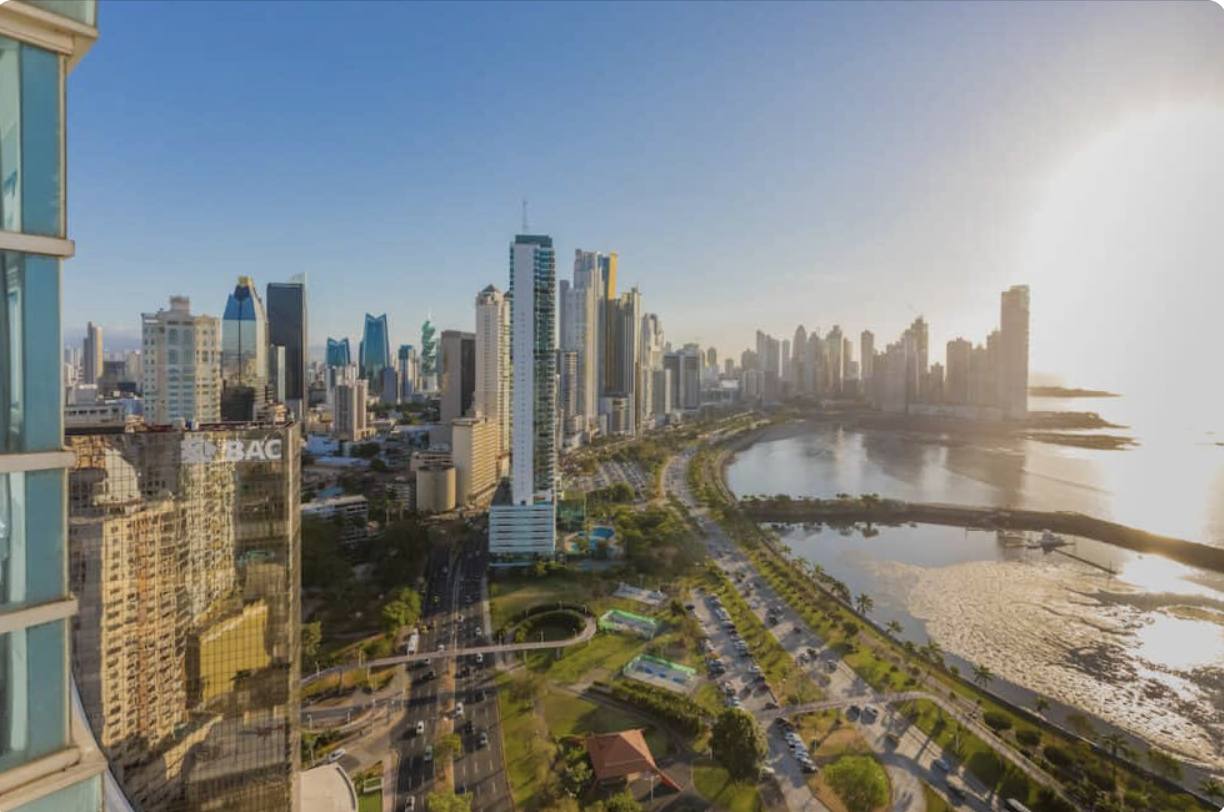
Where they diverge is in the things that shape daily quality of life. Panama uses the US dollar. Its private healthcare system is deep and internationally accredited. Its residential neighborhoods — Costa del Este, Clayton, Punta Pacifica — offer a level of day-to-day security that most Trinidadian families have not experienced in their own country. And its geographic position, with direct flights to Miami, Bogota, Mexico City, and most of Central and South America, makes it a genuinely connected base rather than an island that requires a connection through Miami to reach anywhere else.
What follows is what we actually tell Trinidad clients during their first conversation with us. If any of these trade-offs feels wrong for your situation, that is worth knowing now.
Security: the conversation that starts every engagement
There is no way to write honestly about the Trinidad-to-Panama comparison without starting here. Trinidad and Tobago has one of the highest per-capita homicide rates in the Caribbean, and the broader pattern — armed robberies, kidnappings for ransom, home invasions in areas that were considered safe a generation ago — has reshaped how middle-class and upper-middle-class families live. Gated compounds, private security, restricted movement after dark, children who cannot walk to a friend's house: this is the texture of daily life for many of our Trini clients, and it is the single most common reason they contact us.
Panama City is not crime-free. No city of 1.5 million people is. But the residential neighborhoods where our clients live — Costa del Este, Clayton, Punta Pacifica, Santa Maria — operate at a fundamentally different security level. Children walk to the park. Families eat dinner at outdoor restaurants at ten o'clock at night. The shift, as our Trinidadian clients consistently describe it, is not from danger to safety in some absolute sense; it is from a life organized around avoiding risk to a life where risk is background noise rather than the dominant signal. For families with children, this alone is often sufficient to justify the move.
Cost of living: a different equation than you expect
Unlike moves from Cayman or Bermuda, the Trinidad-to-Panama comparison is not primarily a cost-saving story. Trinidad is actually affordable by Caribbean standards — local food is cheap, energy is subsidized, and the cost of domestic help is a fraction of what it runs elsewhere in the region. The savings narrative that dominates our conversations with Cayman clients does not apply here in the same way.
Housing tells a more nuanced story. A good apartment in Westmoorings, Maraval, or St. Clair runs TT$13,000 to TT$24,000 per month (roughly US$2,000 to US$3,500 at the official rate). Comparable apartments in Panama City's better neighborhoods — Costa del Este, Clayton, Punta Pacifica — range from US$2,200 to US$3,500 per month. The numbers look similar, but what you get is different: newer construction, better-maintained common areas, 24-hour concierge security that actually functions, and reliable utilities. The value equation is less about paying less and more about getting more for what you pay.
Groceries in Panama are moderately more expensive than T&T's subsidized local prices, but imported goods — anything branded, anything you currently struggle to find on shelves in Trinidad — are dramatically more available and closer to US retail pricing. Dining out is comparable. Healthcare costs are addressed below, but on an ongoing basis, the combination of Panama's private healthcare pricing and available international insurance plans generally compares favorably to the combination of private care and medical travel that many Trini families currently manage. Independent sources such as Numbeo's Panama City vs. Port of Spain comparison provide a starting framework, though they tend to underweight the security and reliability dimensions that matter most to our clients.
Currency: from managed float to dollar economy
This is the second conversation, right after security, for nearly every Trinidadian client. The TT dollar trades at approximately 6.8 to 1 USD on the official market, but anyone who has tried to buy foreign exchange through a commercial bank in Trinidad in recent years knows that the official rate is only half the story. The practical reality — long waits, allocation limits, informal parallel markets — means that accessing USD for savings, investment, or international transactions has become a source of genuine friction in daily financial life.
Panama's economy is dollarized. It has used the US dollar since 1904. There is no forex queue, no allocation limit, no parallel rate. Your salary, your savings, your rent, your groceries — everything is denominated in the currency that the rest of the world prices things in. For Trinidadian professionals and business owners who have spent years managing around TT dollar constraints, this is not a minor convenience. It is a structural change in how your financial life works. It also means that the practical challenge of funding a move to Panama — accumulating the USD needed for deposits, investments, and initial setup — requires advance planning. We advise clients to begin the forex accumulation process well before they intend to move, and we can discuss strategies for this during an initial conversation.
Healthcare: depth you don't have to fly for
Trinidad has respectable medical infrastructure. The Eric Williams Medical Sciences Complex at Mt. Hope is a teaching hospital with genuine capability, and private facilities like St. Clair Medical Centre and Medical Associates handle much of the routine care for middle-class families. But the public system is strained — specialist wait times are long, equipment is intermittently available, and for anything beyond routine care, many Trinidadian families already fly to Miami, Barbados, or occasionally further afield.
In Panama City, Pacifica Salud (formerly Hospital Punta Pacifica) is accredited by Joint Commission International and affiliated with Johns Hopkins Medicine International. The specialist depth is genuine: cardiology, oncology, orthopedics, neurology, and high-risk obstetrics are all available in-city from physicians who trained at US or European teaching hospitals. Other strong private hospitals include The Panama Clinic, Hospiten Paitilla, and Hospital Nacional. International health insurance — Bupa Global, Cigna Global, Allianz Care, and locally ASSA — is straightforward to arrange and widely accepted.
The practical difference is that in Panama, your cardiologist, your children's pediatrician, and your specialist referrals are all in the same city. You stop organizing your medical life around flights.
Schools: from prestige local to international curriculum
Trinidad has genuinely good schools. The prestige secondary schools — St. Mary's College, Bishop Anstey, Fatima College, Naparima College, Presentation College — produce students who compete internationally. The SEA examination system and the culture of academic achievement are real. But the curriculum is largely local (CXC/CAPE), international school options in Port of Spain are limited, and for families planning to educate children who may attend university in the US, Canada, UK, or Europe, the curriculum alignment question becomes significant at secondary level.
Panama City offers a mature international school ecosystem. The International School of Panama (ISP) runs a full IB programme and is widely considered the strongest international option in the country. Balboa Academy offers an American curriculum with AP courses. The Metropolitan School of Panama is IB, newer, and growing quickly. Colegio Brader, historically the school of established Panamanian families, also offers IB. For families in Costa del Este, Academia Interamericana de Panama (AIP) provides proximity and a solid bilingual programme. Fees at the top international schools run US$12,000 to US$22,000 per year — comparable to or lower than the combined costs of prestige private schooling and supplementary preparation in Trinidad, and the curriculum portability is significantly better.
Waiting lists exist for popular year groups. We recommend engaging admissions offices six to nine months ahead of a planned move.
Residency: the Friendly Nations route
Trinidad and Tobago is on Panama's Friendly Nations list, which means Trinidadian citizens can apply for the Friendly Nations Visa — one of the more straightforward permanent residency pathways Panama offers. The process requires a Panamanian immigration lawyer (we work with two firms we trust), an economic tie to Panama (typically a job offer, business formation, or bank deposit), and a set of legalized documents from Trinidad. Processing times vary but typically run several months to about a year.
The specific practical challenge for Trinidadian applicants is the forex dimension. The economic tie — whether it is a bank deposit or an investment — needs to be funded in USD, and accumulating that USD through Trinidad's commercial banking system takes time and planning. This is not a legal obstacle; it is a logistical one. We raise it early because clients who start the forex process when they start the residency paperwork move through the timeline much more smoothly than those who treat it as an afterthought. The authoritative source on current requirements is the Servicio Nacional de Migracion de Panama.
Tax: a meaningful shift that requires professional review
Trinidad and Tobago levies income tax at rates of 25% on the first TT$1 million and 30% above that. Corporation tax sits at 30%. VAT (value added tax) runs at 12.5%. For professionals and business owners earning well, the combined tax burden is substantial and has been increasing as the government looks for revenue to offset declining energy receipts.
Panama operates a territorial tax system: income earned outside Panama is generally not taxed by Panama. For Trinidadian clients whose businesses or investments generate income from sources outside Panama, this represents a meaningful structural difference. But — and this is important — the interaction between Trinidad's tax obligations, any ongoing income sources in T&T, and Panama's territorial system requires professional cross-border tax advice. We refer clients to reputable specialists for their specific situation. For general background, the OECD tax centre and the IMF country profile for Panama are credible starting points. Do not make a relocation decision based on tax assumptions that have not been reviewed by someone qualified.
The quieter trade-offs
The line items above are the ones that fit in a spreadsheet. The things below are the ones that determine whether you are happy eighteen months after the move.
You are trading cultural intensity for peace of mind. That is a real trade, and you should make it with open eyes.
Trini culture is irreplaceable. Carnival is not something you can approximate. Doubles at three in the morning after a fete is not something Panama can offer you. The lime — that particular Trinidadian art of gathering, talking, eating, being present with people — does not have a direct equivalent anywhere else. Port of Spain's energy, its music, its food culture, the way an entire country can organize itself around a season of celebration: these are genuine losses, and we say that plainly rather than pretending that Panama's restaurant scene or nightlife is a substitute. It is not. It is different.
What Panama does have is a small but growing Trinidadian community, and a broader Caribbean diaspora that provides some cultural continuity. You will find doubles in Panama City — not the same, but present. You will find soca at the right parties. You will find people who understand the references. It is not home, but it is not cultural isolation either.
You lose Trinidad's natural beauty in its specific form — the Northern Range, Maracas Bay, Tobago's unspoiled Caribbean coast, the birdwatching, the turtle-nesting beaches. You gain Panama's different landscape: the highlands around Boquete and El Valle, the Pacific coast beaches at Coronado and Pedasi, the San Blas islands on the Caribbean side, a canal that splits a continent. Both countries have genuine natural depth. They are simply different kinds of beautiful.
You gain professional oxygen. Panama City has a real professional ecosystem — regional headquarters, legal and financial services, logistics, consulting, a growing technology sector — that provides career and business options beyond what Port of Spain's more concentrated economy offers. For dual-career families, this matters more than it seems on paper.
You gain regional connectivity. From Tocumen International Airport, you are two and a half hours from Miami, three from Bogota, five from New York. Trinidad's Piarco, by comparison, requires connections through Miami or regional hubs to reach most destinations. If your work or family requires regular travel, the difference in flight options is substantial.
How to think about the decision
We are biased — we are a Panama advisory, and we do not pretend otherwise. What we can say honestly is that of the Trinidadian clients we have worked with, the ones who move and stay consistently report two things: the security transformation was even more significant than they expected, and they underestimated how much mental energy the forex and currency situation in Trinidad had been consuming. The biggest adjustment is cultural — the loss of that particular Trinidadian social warmth, the feeling of being somewhere that is efficient and functional but does not yet feel like home in the way Trinidad did, even with all its problems.
If you are seriously considering this, the next step is a conversation — forty-five minutes, free, no follow-up unless you ask. We will tell you honestly whether Panama fits what you are looking for, and if it does not, we will say so.
Sources & further reading
- Numbeo — Panama City vs. Port of Spain cost comparison: numbeo.com
- Joint Commission International — accredited organizations directory: jointcommissioninternational.org
- Servicio Nacional de Migracion de Panama — visa categories: migracion.gob.pa
- IMF country profile — Panama: imf.org/en/Countries/PAN
- OECD tax centre: oecd.org/tax
- World Bank country data — Panama: data.worldbank.org/country/panama
- UNODC — global homicide statistics: dataunodc.un.org
- Central Bank of Trinidad and Tobago — exchange rate data: central-bank.org.tt